The Breach That Started Inside
The attacker was already inside. Had been for three weeks.
A contractor's laptop - connected to the corporate VPN - had been compromised through a phishing email. The malware sat quietly, scanning the internal network. No alarms. Why would there be? The traffic came from inside the perimeter.
By the time the SOC noticed unusual database queries, the attacker had mapped the entire network, escalated privileges through an unpatched internal server, and exfiltrated 4TB of customer data. Total time from initial access to exfiltration: 19 days. Time inside the "trusted" network without detection: 18 of those days.
"But they were on the VPN," the incident report noted. "They were inside the firewall."
That's the problem. The perimeter model assumed "inside" meant "trusted." It doesn't. It never did. The attacker proved it.
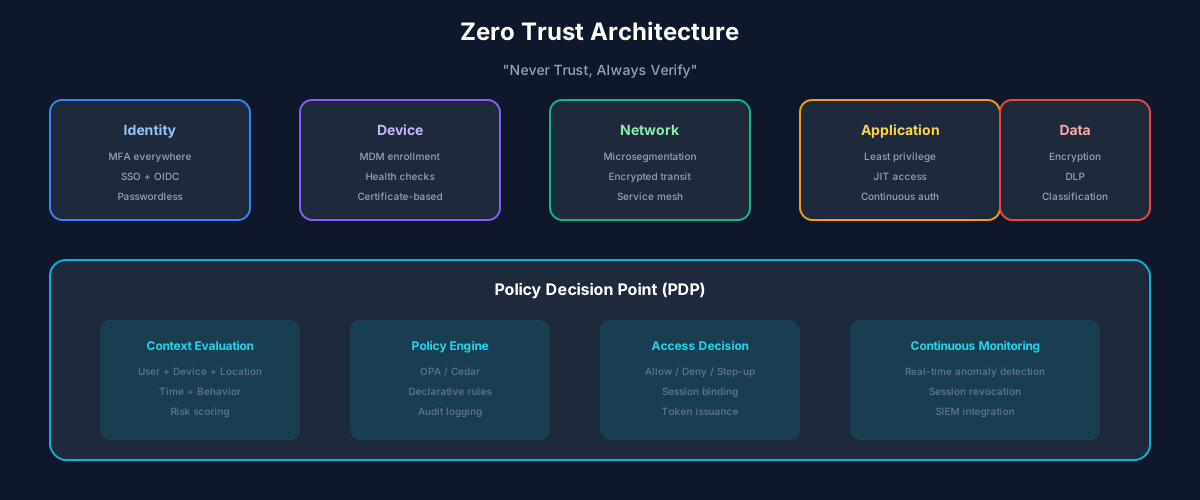
Zero Trust starts from a different premise: trust nothing, verify everything, regardless of location or network. There is no "inside" and "outside" - there's only authenticated, authorized, and verified... or not.
Here's how to build systems that assume breach from day one.
The Zero Trust Principles
Zero Trust is not a product you can buy. It is an architectural philosophy built on several core principles.
Verify Explicitly
Every access request must be authenticated and authorized. Not just at the perimeter - at every resource, every time. Identity is verified continuously, not just at login.
This means:
Least Privilege Access
Users and systems get the minimum access needed for their task, nothing more. Access is granted just-in-time and just-enough.
This means:
Assume Breach
Design systems assuming attackers are already inside. Minimize blast radius. Detect anomalies. Contain damage quickly.
This means:
Identity: The New Perimeter
In Zero Trust, identity replaces the network perimeter as the primary security control. Every access decision starts with: who is requesting this, and should they have it?
Strong Authentication
Passwords alone are insufficient. Implement defense in depth:
interface AuthenticationPolicy {
  primaryFactor: 'password' | 'passkey' | 'certificate';
  secondFactor: 'totp' | 'webauthn' | 'push' | 'sms';
  adaptiveRules: AdaptiveRule[];
}

interface AdaptiveRule {
  condition: {
    riskScore?: { above: number };
    location?: { outside: string[] };
    device?: { unmanaged: boolean };
    behavior?: { anomalous: boolean };
  };
  action: 'allow' | 'stepUp' | 'deny';
  stepUpFactor?: string;
}

const policy: AuthenticationPolicy = {
  primaryFactor: 'passkey',
  secondFactor: 'webauthn',
  adaptiveRules: [
    {
      condition: { riskScore: { above: 70 } },
      action: 'stepUp',
      stepUpFactor: 'biometric'
    },
    {
      condition: { device: { unmanaged: true } },
      action: 'stepUp',
      stepUpFactor: 'push'
    },
    {
      condition: { location: { outside: ['US', 'CA', 'UK'] } },
      action: 'deny'
    }
  ]
};
Continuous Verification
Authentication is not a one-time event. Verify throughout the session:
class ContinuousAuthVerifier {
  private sessionRiskThreshold = 50;

  async verifySession(session: Session): Promise<VerificationResult> {
    const signals: RiskSignal[] = [
      await this.checkDevicePosture(session.deviceId),
      await this.checkLocationConsistency(session),
      await this.checkBehaviorPattern(session),
      await this.checkTokenValidity(session.accessToken)
    ];

    const riskScore = this.calculateRisk(signals);

    if (riskScore > this.sessionRiskThreshold) {
      if (riskScore > 80) {
        return { action: 'terminate', reason: 'High risk detected' };
      }
      return { action: 'stepUp', reason: 'Elevated risk' };
    }

    return { action: 'continue' };
  }

  private async checkBehaviorPattern(session: Session): Promise<RiskSignal> {
    const recentActions = await this.getRecentActions(session.userId);
    const baseline = await this.getUserBaseline(session.userId);

    const anomalyScore = this.detectAnomalies(recentActions, baseline);

    return {
      type: 'behavior',
      score: anomalyScore,
      details: anomalyScore > 0.7 ? 'Unusual access pattern detected' : null
    };
  }
}
Identity Federation
Centralize identity while distributing access:
// Identity Provider configuration
const idpConfig = {
  provider: 'okta',
  protocols: ['OIDC', 'SAML'],

  // Map identity to access
  claimsMappings: [
    { claim: 'groups', target: 'roles' },
    { claim: 'department', target: 'department' },
    { claim: 'security_clearance', target: 'clearance' }
  ],

  // Session policies
  sessionPolicy: {
    maxDuration: '8h',
    idleTimeout: '30m',
    reauthForSensitive: true
  }
};
Micro-Segmentation
In traditional networks, once you are inside, you can reach almost anything. Micro-segmentation creates granular trust boundaries, limiting lateral movement.
Network-Level Segmentation
Use software-defined networking to create dynamic segments:
# Kubernetes Network Policy
apiVersion: networking.k8s.io/v1
kind: NetworkPolicy
metadata:
  name: api-server-policy
  namespace: production
spec:
  podSelector:
    matchLabels:
      app: api-server
  policyTypes:
    - Ingress
    - Egress
  ingress:
    - from:
        - podSelector:
            matchLabels:
              app: api-gateway
        - namespaceSelector:
            matchLabels:
              name: monitoring
      ports:
        - protocol: TCP
          port: 8080
  egress:
    - to:
        - podSelector:
            matchLabels:
              app: database
      ports:
        - protocol: TCP
          port: 5432
    - to:
        - podSelector:
            matchLabels:
              app: cache
      ports:
        - protocol: TCP
          port: 6379
Application-Level Segmentation
Enforce access control at the application layer:
// Service mesh authorization policy
const authPolicy = {
  service: 'payment-service',
  rules: [
    {
      from: [{ service: 'checkout-service' }],
      to: [{ operation: 'ProcessPayment' }],
      when: [
        { key: 'request.auth.claims[role]', values: ['payment-processor'] }
      ]
    },
    {
      from: [{ service: 'admin-service' }],
      to: [{ operation: 'RefundPayment' }],
      when: [
        { key: 'request.auth.claims[role]', values: ['admin'] },
        { key: 'request.auth.claims[mfa_verified]', values: ['true'] }
      ]
    }
  ],
  defaultAction: 'DENY'
};
Data-Level Segmentation
Protect data based on classification:
interface DataAccessPolicy {
  classification: 'public' | 'internal' | 'confidential' | 'restricted';
  accessRules: AccessRule[];
  encryption: EncryptionRequirement;
  audit: AuditRequirement;
}

const policies: DataAccessPolicy[] = [
  {
    classification: 'restricted',
    accessRules: [
      { role: 'data-scientist', operations: ['read'], approval: 'required' },
      { role: 'admin', operations: ['read', 'write'], approval: 'required', mfa: true }
    ],
    encryption: { atRest: 'AES-256', inTransit: 'TLS-1.3', keyRotation: '30d' },
    audit: { level: 'full', retention: '7y', realTimeAlerts: true }
  }
];
Device Trust
Zero Trust extends to devices. A valid identity on a compromised device is still a risk.
Device Posture Assessment
Evaluate device health before granting access:
interface DevicePosture {
  managed: boolean;
  osVersion: string;
  osPatched: boolean;
  diskEncrypted: boolean;
  firewallEnabled: boolean;
  antivirusActive: boolean;
  jailbroken: boolean;
  lastSeen: Date;
}

function assessDeviceRisk(posture: DevicePosture): number {
  let risk = 0;

  if (!posture.managed) risk += 20;
  if (!posture.osPatched) risk += 30;
  if (!posture.diskEncrypted) risk += 25;
  if (!posture.firewallEnabled) risk += 10;
  if (!posture.antivirusActive) risk += 15;
  if (posture.jailbroken) risk += 50;

  const hoursSinceLastSeen = (Date.now() - posture.lastSeen.getTime()) / 3600000;
  if (hoursSinceLastSeen > 24) risk += 10;

  return Math.min(risk, 100);
}

function determineAccess(
  identity: Identity,
  device: DevicePosture,
  resource: Resource
): AccessDecision {
  const deviceRisk = assessDeviceRisk(device);

  if (deviceRisk > 70 && resource.sensitivity === 'high') {
    return { decision: 'deny', reason: 'Device risk too high for sensitive resource' };
  }

  if (deviceRisk > 50) {
    return { decision: 'allow', conditions: ['read-only', 'no-download'] };
  }

  return { decision: 'allow' };
}
Managed vs. Unmanaged Devices
Different policies for different device types:
# Access policy by device type
managedCorporateDevice:
  resources: all
  mfa: risk-based
  sessionDuration: 8h
  dataOperations: [read, write, download]

managedPersonalDevice:
  resources: [email, collaboration, internal-apps]
  mfa: always
  sessionDuration: 4h
  dataOperations: [read, write]
  restrictions:
    - no-download-confidential
    - watermark-documents

unManagedDevice:
  resources: [email-web, collaboration-web]
  mfa: always
  sessionDuration: 1h
  dataOperations: [read]
  restrictions:
    - no-download
    - no-copy-paste
    - session-recording
Encryption Everywhere
Zero Trust assumes the network is hostile. Encrypt everything.
Mutual TLS (mTLS)
Both client and server verify each other's identity:
// Service mesh mTLS configuration
const mtlsPolicy = {
  mode: 'STRICT',  // Require mTLS for all traffic

  certificateRotation: {
    interval: '24h',
    gracePeriod: '1h'
  },

  trustDomain: 'cluster.local',

  allowedCipherSuites: [
    'TLS_AES_256_GCM_SHA384',
    'TLS_CHACHA20_POLY1305_SHA256'
  ],

  minimumProtocolVersion: 'TLSv1.3'
};
Data Encryption
Protect data at every layer:
class DataProtection {
  // Encrypt at rest
  async storeSecurely(data: Buffer, classification: string): Promise<string> {
    const key = await this.getEncryptionKey(classification);
    const encrypted = await this.encrypt(data, key);
    const id = await this.storage.store(encrypted);

    await this.audit.log({
      action: 'store',
      dataId: id,
      classification,
      timestamp: new Date()
    });

    return id;
  }

  // Encrypt in transit (beyond TLS)
  async prepareForTransit(data: Buffer, recipient: string): Promise<EncryptedPayload> {
    const recipientPublicKey = await this.getRecipientKey(recipient);
    const ephemeralKey = await this.generateEphemeralKey();

    return {
      data: await this.encrypt(data, ephemeralKey),
      key: await this.encryptKey(ephemeralKey, recipientPublicKey),
      algorithm: 'AES-256-GCM',
      keyExchange: 'ECDH-P384'
    };
  }
}
Logging and Monitoring
You cannot defend what you cannot see. Comprehensive logging is essential for Zero Trust.
What to Log
interface SecurityEvent {
  timestamp: Date;
  eventType: SecurityEventType;

  // Identity context
  userId?: string;
  sessionId?: string;
  clientId?: string;

  // Device context
  deviceId?: string;
  devicePosture?: DevicePosture;

  // Network context
  sourceIp: string;
  destinationIp?: string;
  protocol?: string;

  // Resource context
  resourceType: string;
  resourceId: string;
  operation: string;

  // Decision context
  decision: 'allow' | 'deny' | 'challenge';
  decisionReason?: string;
  riskScore?: number;

  // Outcome
  success: boolean;
  errorCode?: string;
}
Anomaly Detection
Look for patterns that indicate compromise:
class AnomalyDetector {
  private readonly rules: AnomalyRule[] = [
    {
      name: 'impossible-travel',
      detect: (events) => {
        const logins = events.filter(e => e.eventType === 'login');
        for (let i = 1; i < logins.length; i++) {
          const distance = this.calculateDistance(
            logins[i-1].location,
            logins[i].location
          );
          const timeDiff = logins[i].timestamp - logins[i-1].timestamp;
          const requiredTime = distance / 1000; // hours at 1000 km/h

          if (timeDiff < requiredTime * 3600000) {
            return { detected: true, severity: 'high' };
          }
        }
        return { detected: false };
      }
    },
    {
      name: 'unusual-data-access',
      detect: (events) => {
        const dataAccess = events.filter(e => e.eventType === 'data-access');
        const baseline = this.getUserBaseline(events[0].userId);

        const accessVolume = dataAccess.length;
        if (accessVolume > baseline.avgVolume * 10) {
          return { detected: true, severity: 'medium' };
        }
        return { detected: false };
      }
    }
  ];

  async analyze(userId: string, timeWindow: string): Promise<AnomalyReport> {
    const events = await this.getEvents(userId, timeWindow);
    const anomalies: Anomaly[] = [];

    for (const rule of this.rules) {
      const result = rule.detect(events);
      if (result.detected) {
        anomalies.push({
          rule: rule.name,
          severity: result.severity,
          events: events
        });
      }
    }

    return { userId, timeWindow, anomalies };
  }
}
Implementation Journey
Zero Trust is a journey, not a destination. Here is a practical roadmap:
Phase 1: Foundation (Months 1-3)
Phase 2: Network Controls (Months 4-6)
Phase 3: Advanced Controls (Months 7-12)
Phase 4: Optimization (Ongoing)
Common Pitfalls
Starting Too Big
Zero Trust for everything at once overwhelms teams. Start with your most critical assets and expand.
Ignoring User Experience
Security that makes work impossible gets bypassed. Balance protection with productivity.
Technology Over Process
Buying a "Zero Trust product" without changing processes accomplishes nothing. Zero Trust is a philosophy implemented through people, process, and technology.
Treating It as a Project
Zero Trust is not a project with an end date. It is an ongoing security posture that evolves with threats.
The Zero Trust Future
Zero Trust is becoming the default security model. Regulatory frameworks reference it. Cloud providers build it in. The question is not whether to adopt Zero Trust, but how quickly you can get there.
The perimeter is gone. Trust must be earned, verified, and continuously reassessed. In a world where attackers are inside your network from day one, Zero Trust is not paranoia - it is realism.
Start today. Inventory your assets. Strengthen your identity foundation. Segment your network. Log everything. Assume breach. Never trust, always verify.
Recommended Reading
💬Discussion
No comments yet
Be the first to share your thoughts!