The Shared Responsibility Model
Cloud security is a shared responsibility between you and your cloud provider. Understanding this boundary is critical.
Provider Responsibilities
Your Responsibilities
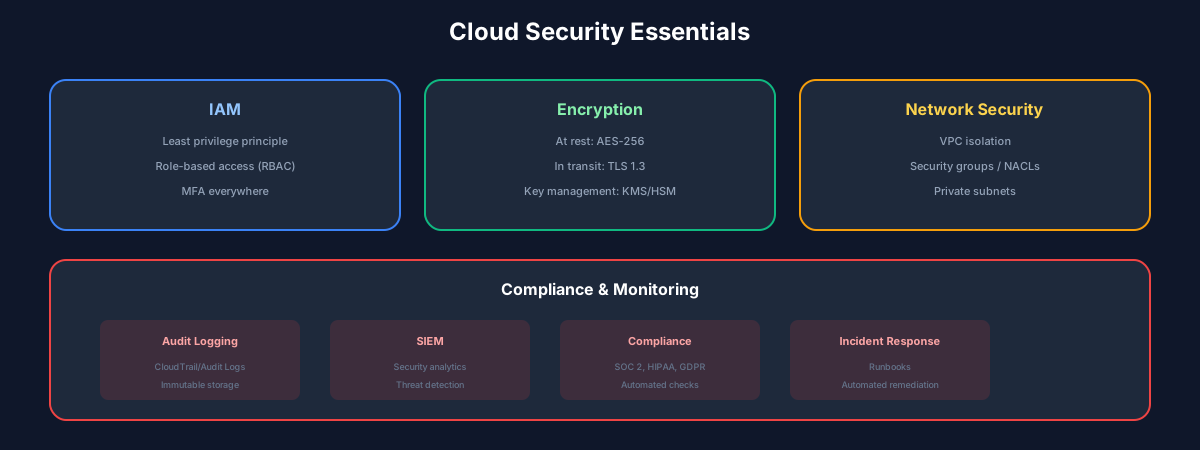
Identity and Access Management (IAM)
Principle of Least Privilege
JSON
{
  "Version": "2012-10-17",
  "Statement": [
    {
      "Effect": "Allow",
      "Action": [
        "s3:GetObject",
        "s3:PutObject"
      ],
      "Resource": "arn:aws:s3:::my-bucket/uploads/*",
      "Condition": {
        "IpAddress": {
          "aws:SourceIp": "10.0.0.0/8"
        }
      }
    }
  ]
}
IAM Best Practices
Service Accounts
TypeScript
// Using IAM roles for service authentication
const AWS = require('aws-sdk');

// The SDK automatically uses the IAM role attached to the resource
const s3 = new AWS.S3(); // No credentials needed!

// For local development, use assume role
const sts = new AWS.STS();
const credentials = await sts.assumeRole({
  RoleArn: 'arn:aws:iam::123456789:role/MyRole',
  RoleSessionName: 'MySession'
}).promise();
Encryption
Encryption at Rest
YAML
# AWS KMS-encrypted S3 bucket
AWSTemplateFormatVersion: '2010-09-09'
Resources:
  EncryptedBucket:
    Type: AWS::S3::Bucket
    Properties:
      BucketEncryption:
        ServerSideEncryptionConfiguration:
          - ServerSideEncryptionByDefault:
              SSEAlgorithm: aws:kms
              KMSMasterKeyID: !Ref MyKMSKey

  MyKMSKey:
    Type: AWS::KMS::Key
    Properties:
      EnableKeyRotation: true
      KeyPolicy:
        Version: '2012-10-17'
        Statement:
          - Effect: Allow
            Principal:
              AWS: !Sub 'arn:aws:iam::${AWS::AccountId}:root'
            Action: 'kms:*'
            Resource: '*'
Encryption in Transit
Always use TLS 1.2 or higher:
TypeScript
// Force HTTPS in Express
app.use((req, res, next) => {
  if (req.headers['x-forwarded-proto'] !== 'https') {
    return res.redirect(`https://${req.hostname}${req.url}`);
  }
  next();
});

// Configure TLS
const https = require('https');
const fs = require('fs');

const options = {
  key: fs.readFileSync('private-key.pem'),
  cert: fs.readFileSync('certificate.pem'),
  minVersion: 'TLSv1.2',
  ciphers: [
    'ECDHE-ECDSA-AES128-GCM-SHA256',
    'ECDHE-RSA-AES128-GCM-SHA256'
  ].join(':')
};
Network Security
VPC Best Practices
HCL
# Terraform VPC configuration
resource "aws_vpc" "main" {
  cidr_block           = "10.0.0.0/16"
  enable_dns_hostnames = true
  enable_dns_support   = true
}

# Public subnet
resource "aws_subnet" "public" {
  vpc_id            = aws_vpc.main.id
  cidr_block        = "10.0.1.0/24"
  availability_zone = "us-east-1a"
}

# Private subnet - no internet gateway
resource "aws_subnet" "private" {
  vpc_id            = aws_vpc.main.id
  cidr_block        = "10.0.2.0/24"
  availability_zone = "us-east-1a"
}

# Security group - restrictive by default
resource "aws_security_group" "app" {
  vpc_id = aws_vpc.main.id

  ingress {
    from_port       = 443
    to_port         = 443
    protocol        = "tcp"
    security_groups = [aws_security_group.alb.id]
  }

  egress {
    from_port   = 0
    to_port     = 0
    protocol    = "-1"
    cidr_blocks = ["0.0.0.0/0"]
  }
}
Web Application Firewall (WAF)
Protect against common attacks:
Security Monitoring
CloudTrail & Logging
JSON
{
  "eventVersion": "1.08",
  "eventName": "ConsoleLogin",
  "awsRegion": "us-east-1",
  "sourceIPAddress": "192.0.2.1",
  "userIdentity": {
    "type": "IAMUser",
    "userName": "admin"
  },
  "responseElements": {
    "ConsoleLogin": "Success"
  }
}
Alerting Rules
Python
# CloudWatch alarm for unauthorized API calls
import boto3

cloudwatch = boto3.client('cloudwatch')

cloudwatch.put_metric_alarm(
    AlarmName='UnauthorizedAPICalls',
    MetricName='UnauthorizedAttemptCount',
    Namespace='CloudTrailMetrics',
    Statistic='Sum',
    Period=300,
    EvaluationPeriods=1,
    Threshold=1,
    ComparisonOperator='GreaterThanOrEqualToThreshold',
    AlarmActions=['arn:aws:sns:us-east-1:123456789:SecurityAlerts']
)
Compliance Frameworks
Conclusion
Cloud security requires a defense-in-depth approach. Implement multiple layers of security and continuously monitor for threats.
Recommended Reading
Recommended Read

Practical Cloud Security
by Chris Dotson
A guide for secure design and deployment
View on Amazon
As an Amazon Associate, we earn from qualifying purchases.
Recommended Read

Zero Trust Networks
by Evan Gilman
Building secure systems in untrusted networks
View on Amazon
As an Amazon Associate, we earn from qualifying purchases.
💬Discussion
🗨️
No comments yet
Be the first to share your thoughts!