Why AI for Testing?
Writing tests is often neglected because it's time-consuming. AI changes this by:
Test Generation Workflow
Step 1: Analyze the Function
TypeScript
const testGenerationPrompt = `Analyze this function and generate comprehensive tests.

Function:
${functionCode}

Consider:
1. Happy path scenarios
2. Edge cases (null, empty, boundary values)
3. Error conditions
4. Type edge cases
5. Async behavior (if applicable)

Output Jest/Vitest tests with descriptive names.`;
Step 2: Generate Tests
TypeScript
async function generateTests(
  functionCode: string,
  context: string
): Promise<string> {
  const response = await openai.chat.completions.create({
    model: 'gpt-4-turbo',
    messages: [
      {
        role: 'system',
        content: `You are a senior QA engineer. Generate comprehensive,
                  meaningful tests. Focus on behavior, not implementation.`
      },
      {
        role: 'user',
        content: `Generate tests for this code.

Context (types, dependencies):
${context}

Code to test:
${functionCode}`
      }
    ],
    temperature: 0.2
  });

  return response.choices[0].message.content;
}
Example: Generated Tests
Given this function:
TypeScript
function calculateDiscount(
  price: number,
  customerType: 'regular' | 'vip' | 'wholesale',
  quantity: number
): number {
  if (price <= 0 || quantity <= 0) {
    throw new Error('Invalid input');
  }

  let discount = 0;

  if (customerType === 'vip') discount = 0.2;
  else if (customerType === 'wholesale') discount = 0.15;
  else if (quantity >= 10) discount = 0.05;

  return price * quantity * (1 - discount);
}
AI generates:
TypeScript
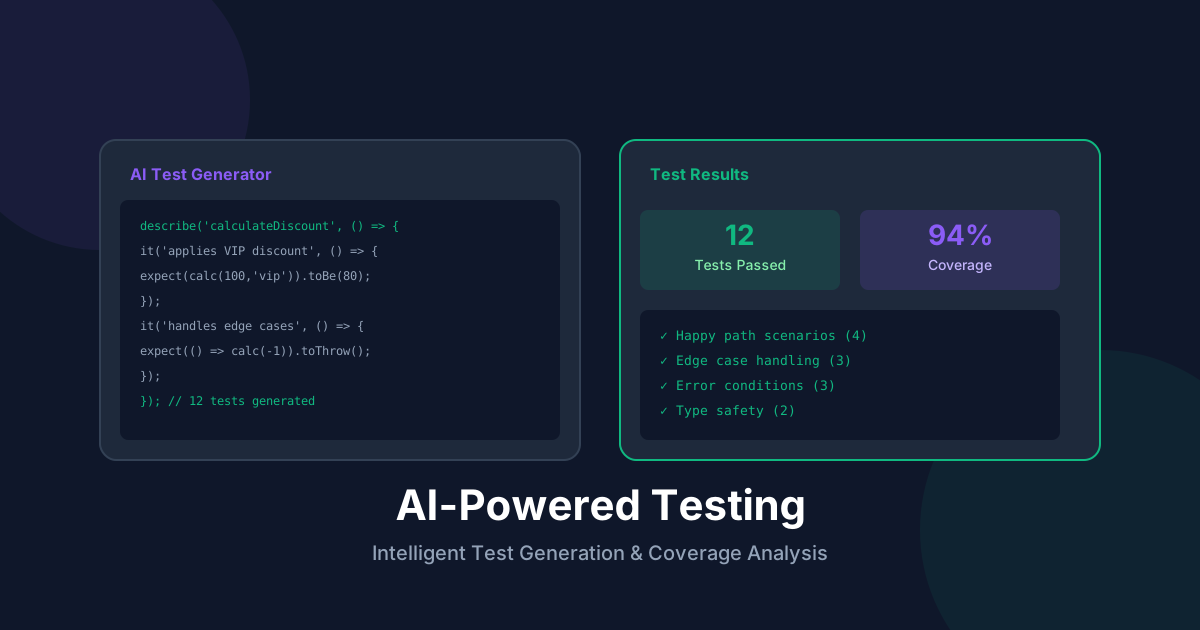
describe('calculateDiscount', () => {
  describe('happy path', () => {
    it('should apply no discount for regular customer with small quantity', () => {
      expect(calculateDiscount(100, 'regular', 5)).toBe(500);
    });

    it('should apply 20% discount for VIP customers', () => {
      expect(calculateDiscount(100, 'vip', 1)).toBe(80);
    });

    it('should apply 15% discount for wholesale customers', () => {
      expect(calculateDiscount(100, 'wholesale', 1)).toBe(85);
    });

    it('should apply 5% bulk discount for regular customers with 10+ items', () => {
      expect(calculateDiscount(100, 'regular', 10)).toBe(950);
    });
  });

  describe('edge cases', () => {
    it('should handle minimum valid quantity', () => {
      expect(calculateDiscount(100, 'regular', 1)).toBe(100);
    });

    it('should handle decimal prices', () => {
      expect(calculateDiscount(99.99, 'vip', 1)).toBeCloseTo(79.992);
    });

    it('should handle quantity at bulk threshold boundary', () => {
      expect(calculateDiscount(100, 'regular', 9)).toBe(900);
      expect(calculateDiscount(100, 'regular', 10)).toBe(950);
    });
  });

  describe('error handling', () => {
    it('should throw for zero price', () => {
      expect(() => calculateDiscount(0, 'regular', 1)).toThrow('Invalid input');
    });

    it('should throw for negative price', () => {
      expect(() => calculateDiscount(-10, 'regular', 1)).toThrow('Invalid input');
    });

    it('should throw for zero quantity', () => {
      expect(() => calculateDiscount(100, 'regular', 0)).toThrow('Invalid input');
    });

    it('should throw for negative quantity', () => {
      expect(() => calculateDiscount(100, 'regular', -1)).toThrow('Invalid input');
    });
  });
});
Integration with CI/CD
YAML
name: AI Test Generation
on:
  push:
    paths:
      - 'src/**/*.ts'

jobs:
  generate-tests:
    runs-on: ubuntu-latest
    steps:
      - uses: actions/checkout@v4

      - name: Detect changed functions
        id: changes
        run: |
          # Extract changed functions
          echo "functions=$(./scripts/detect-changes.sh)" >> $GITHUB_OUTPUT

      - name: Generate missing tests
        run: |
          npx ai-test-gen --files "${{ steps.changes.outputs.functions }}"

      - name: Run generated tests
        run: npm test

      - name: Create PR with new tests
        if: success()
        uses: peter-evans/create-pull-request@v5
        with:
          title: 'test: AI-generated tests for new functions'
          branch: ai-tests/${{ github.sha }}
Test Quality Validation
TypeScript
async function validateTestQuality(tests: string): Promise<ValidationResult> {
  // Run mutation testing
  const mutationScore = await runMutationTesting(tests);

  // Check coverage
  const coverage = await runCoverage(tests);

  // Analyze test structure
  const analysis = await analyzeTestStructure(tests);

  return {
    mutationScore,
    coverage,
    hasEdgeCases: analysis.edgeCaseCount > 0,
    hasErrorHandling: analysis.errorTestCount > 0,
    isReadable: analysis.readabilityScore > 0.8
  };
}
Best Practices
Recommended Reading

💬Discussion
🗨️
No comments yet
Be the first to share your thoughts!