The Art of AI Collaboration
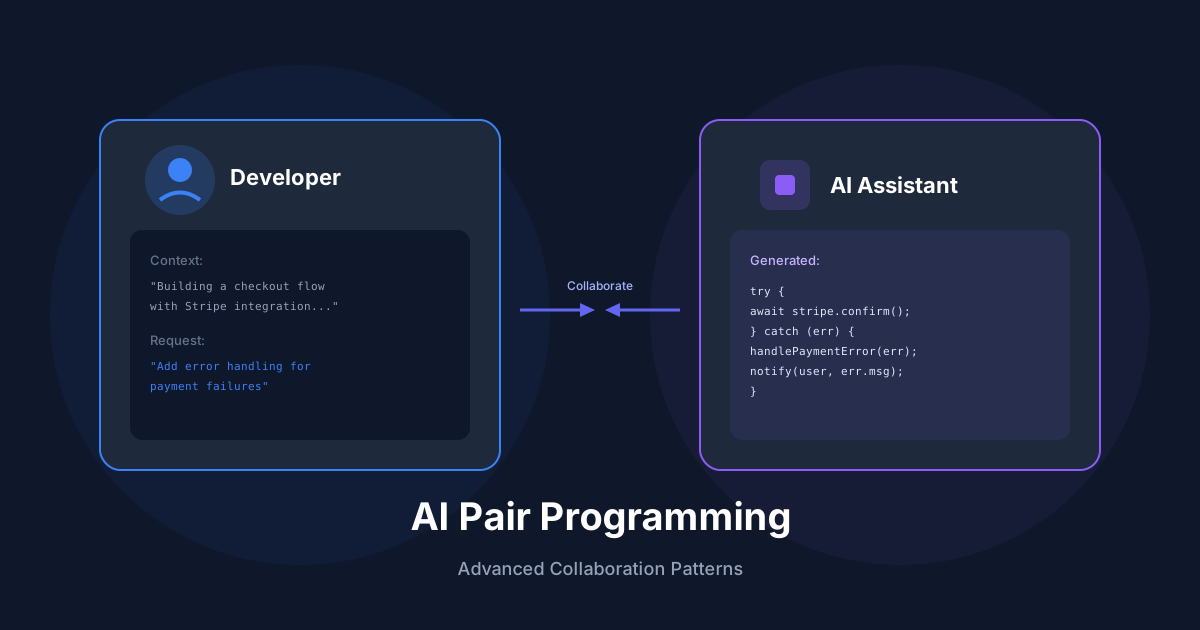
Effective AI pair programming isn't just prompting - it's a dynamic collaboration where you leverage AI's strengths while applying your judgment.
Context Management Patterns
The Layered Context Pattern
Build context in layers, from broad to specific:
Markdown
Layer 1: Project Context
"This is a Next.js 15 e-commerce app using TypeScript, Prisma, and Stripe."

Layer 2: Domain Context
"We're working on the checkout flow. Users add items to cart,
enter shipping info, and pay with Stripe."

Layer 3: Task Context
"I need to implement the shipping address validation
with USPS API integration."

Layer 4: Constraints
"Must handle PO boxes, international addresses, and
return user-friendly error messages."
The Reference Pattern
Point to existing code as examples:
TypeScript
// Show AI an existing pattern
"Here's how we handle API routes in this project:

// src/app/api/products/route.ts
export async function GET(request: Request) {
  const { searchParams } = new URL(request.url);
  const category = searchParams.get('category');

  const products = await prisma.product.findMany({
    where: category ? { category } : undefined,
  });

  return Response.json({ data: products });
}

Now create a similar route for orders with pagination."
Iterative Refinement Patterns
The Scaffolding Pattern
Start with structure, then fill details:
Plain Text
Step 1: "Create the interface and function signature for
        a ShippingCalculator class"

Step 2: "Implement the calculateRate method using
        the FedEx API"

Step 3: "Add error handling for network failures
        and invalid addresses"

Step 4: "Add caching with a 1-hour TTL"
The Critique Pattern
Ask AI to review its own work:
Markdown
"Review the code you just generated for:
1. Security vulnerabilities
2. Performance issues
3. Edge cases not handled
4. TypeScript strict mode compliance

Then provide an improved version."
The Alternative Pattern
Generate multiple solutions:
Markdown
"Provide three different approaches to implement
rate limiting:
1. In-memory with Map
2. Redis-based distributed
3. Token bucket algorithm

Compare trade-offs for each."
Problem-Solving Collaboration
Debugging Together
Markdown
"I'm seeing this error when submitting the form:

Error: Cannot read property 'email' of undefined
  at validateUser (src/lib/validation.ts:24)

Here's the relevant code:
[paste code]

The form data looks correct in DevTools.
Help me trace where the data gets lost."
Architecture Discussions
Markdown
"I need to decide between two approaches for
handling real-time notifications:

Option A: WebSockets with Socket.io
Option B: Server-Sent Events

Our requirements:
- 10,000 concurrent users
- Messages are server→client only
- Must work behind corporate proxies
- Deployed on Vercel

Walk me through the trade-offs."
Effective Prompting Patterns
The Persona Pattern
Markdown
"Act as a senior security engineer reviewing this
authentication implementation. Identify vulnerabilities
and suggest fixes with code examples."
The Constraint Pattern
Markdown
"Implement this feature with the following constraints:
- No external dependencies
- Must work in Node.js 18+
- Maximum 50 lines of code
- Must be testable without mocking"
The Teaching Pattern
Markdown
"Explain this regex pattern step by step, then
show me how to modify it to also match
international phone numbers:

/^\+?1?[-. ]?\(?\d{3}\)?[-. ]?\d{3}[-. ]?\d{4}$/"
Anti-Patterns to Avoid
❌ The Dump Pattern
Markdown
Bad: "Here's my 500-line file, fix it"
Good: "Here's the specific function that's failing [paste].
      The expected behavior is X but I'm getting Y."
❌ The Vague Pattern
Markdown
Bad: "Make this better"
Good: "Refactor this function to:
      - Reduce cognitive complexity
      - Handle null cases
      - Add TypeScript strict types"
❌ The Blind Trust Pattern
Markdown
Bad: Copy-paste without review
Good: "Let me verify this handles the edge case
      where the user array is empty..."
Session Management
Starting a Session
Markdown
"Starting a new coding session. Context:
- Project: E-commerce checkout refactor
- Today's goal: Implement guest checkout flow
- Key files: src/app/checkout/*, src/lib/cart.ts
- Constraints: Must maintain backward compatibility"
Maintaining Context
Markdown
"Continuing from earlier - we implemented the
address form. Now let's add the payment step.
Remember we're using Stripe Elements and
need to handle 3D Secure."
Ending a Session
Markdown
"Before we end, summarize:
1. What we implemented
2. What's left to do
3. Any technical debt we introduced
4. Suggested next steps"
Best Practices
Recommended Reading

💬Discussion
🗨️
No comments yet
Be the first to share your thoughts!