Understanding Containers
Containers provide lightweight, portable, and consistent environments for running applications. Unlike virtual machines, containers share the host OS kernel, making them significantly more efficient.
Docker Fundamentals
Docker revolutionized containerization by providing an easy-to-use platform for building, shipping, and running containers.
#### Creating a Dockerfile
# Multi-stage build for production
FROM node:20-alpine AS builder
WORKDIR /app
COPY package*.json ./
RUN npm ci --only=production
COPY . .
RUN npm run build

FROM node:20-alpine AS runner
WORKDIR /app
COPY --from=builder /app/dist ./dist
COPY --from=builder /app/node_modules ./node_modules
EXPOSE 3000
CMD ["node", "dist/server.js"]
Docker Compose for Local Development
version: '3.8'
services:
  app:
    build: .
    ports:
      - "3000:3000"
    environment:
      - DATABASE_URL=postgres://db:5432/app
    depends_on:
      - db

  db:
    image: postgres:15-alpine
    environment:
      POSTGRES_DB: app
      POSTGRES_PASSWORD: secret
    volumes:
      - postgres_data:/var/lib/postgresql/data

volumes:
  postgres_data:
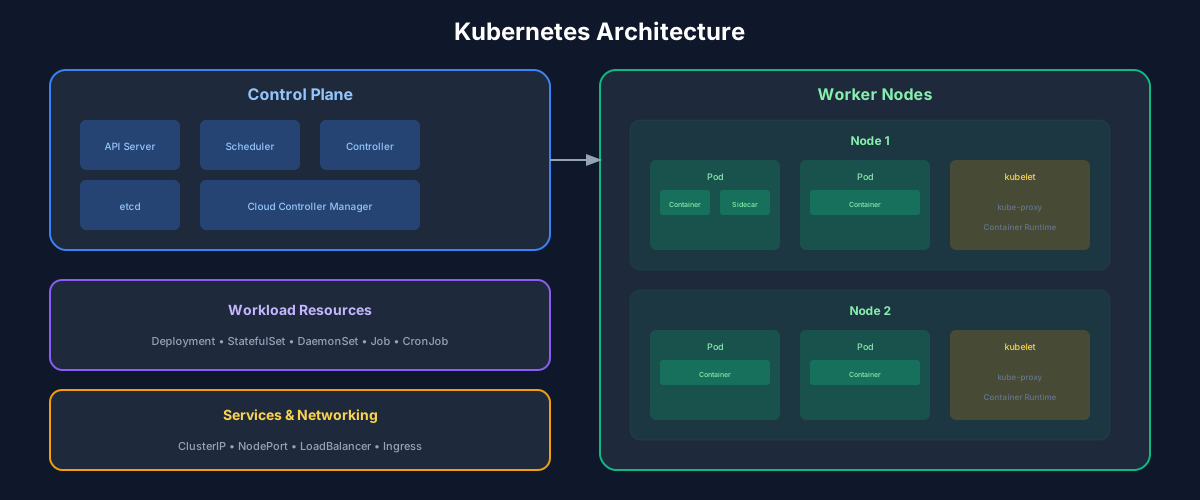
Kubernetes Architecture
Kubernetes (K8s) orchestrates containerized workloads across a cluster of machines.
Core Components
Control Plane:
Worker Nodes:
Kubernetes Resources
#### Deployments
apiVersion: apps/v1
kind: Deployment
metadata:
  name: webapp
spec:
  replicas: 3
  selector:
    matchLabels:
      app: webapp
  template:
    metadata:
      labels:
        app: webapp
    spec:
      containers:
      - name: webapp
        image: myapp:1.0.0
        ports:
        - containerPort: 3000
        resources:
          requests:
            memory: "128Mi"
            cpu: "100m"
          limits:
            memory: "256Mi"
            cpu: "200m"
        livenessProbe:
          httpGet:
            path: /health
            port: 3000
          initialDelaySeconds: 30
          periodSeconds: 10
#### Services
apiVersion: v1
kind: Service
metadata:
  name: webapp-service
spec:
  type: LoadBalancer
  selector:
    app: webapp
  ports:
  - port: 80
    targetPort: 3000
Scaling Strategies
Horizontal Pod Autoscaler (HPA):
apiVersion: autoscaling/v2
kind: HorizontalPodAutoscaler
metadata:
  name: webapp-hpa
spec:
  scaleTargetRef:
    apiVersion: apps/v1
    kind: Deployment
    name: webapp
  minReplicas: 2
  maxReplicas: 10
  metrics:
  - type: Resource
    resource:
      name: cpu
      target:
        type: Utilization
        averageUtilization: 70
Production Best Practices
Conclusion
Docker and Kubernetes form the foundation of modern cloud-native applications. Master these tools to build scalable, resilient systems.
Recommended Reading

Kubernetes in Action
by Marko Lukša
Deep dive into Kubernetes concepts and operations
As an Amazon Associate, we earn from qualifying purchases.

Docker Deep Dive
by Nigel Poulton
The most comprehensive Docker book available
As an Amazon Associate, we earn from qualifying purchases.
💬Discussion
No comments yet
Be the first to share your thoughts!